There is something eerie, beautiful, and convicting about sitting in an empty sanctuary in darkness. No candles are lit, no sunlight or streetlight is pouring in through the windows. Not even second-hand light from the happy voices down in the fellowship hall rejoicing after having watched a movie. None of that. It’s just me sitting in the pew, looking at the communion ware on the altar stationed between the two candelabras with hardened dripped wax from the previous Sunday’s Easter celebration.
Rain falls down on the outside, pitter-pattering against the windows as it rebounds off the roof. A slightly slow yet constant dripping from a mysterious spot in the sanctuary echoes through the darkness. Very symbolic of my current state of mind as I meditate on the upcoming Sunday’s sermon.
After the death and burial of Jesus, the disciples – the same ones who abandoned Jesus in his hour of distress – are locked away cowering in the upper room “for fear of the Jews” (John 20:19). They may have had good reason to be. After all, who knows when they might run into someone who was thirsty for the blood of anyone who would have associated with Jesus? And even though these doors are locked, Jesus appears to them as if out of nowhere. A ghost perhaps? Jesus debunks this myth by showing them his hands and side. Oh, the joy that must have radiated through that room! Christ is risen!
But there was one who was not there. “We have seen the Lord!” the disciples tell Thomas (John 20:25). One would think that Thomas might share in the excitement of the others. But he does not. Still mourning the loss of his friend, he gloomily says, “Unless I see in his hands the mark of the nails, and place my finger into the mark of the nails, and place my hand into his side, I will never believe.”
Pigs will fly on this cold day in hell when Thomas believes without seeing his Lord. But once again, Jesus fulfills the needs of his friends. “Put your finger here, and see my hands; and put out your hand, and place it in my side,” Jesus says eight days later, urging Thomas to believe (John 20:27). Thomas believes because he sees and touches his Lord and only on this condition, earning him the name that will be etched in history books forever: Doubting Thomas. A bit unfair if you ask me.
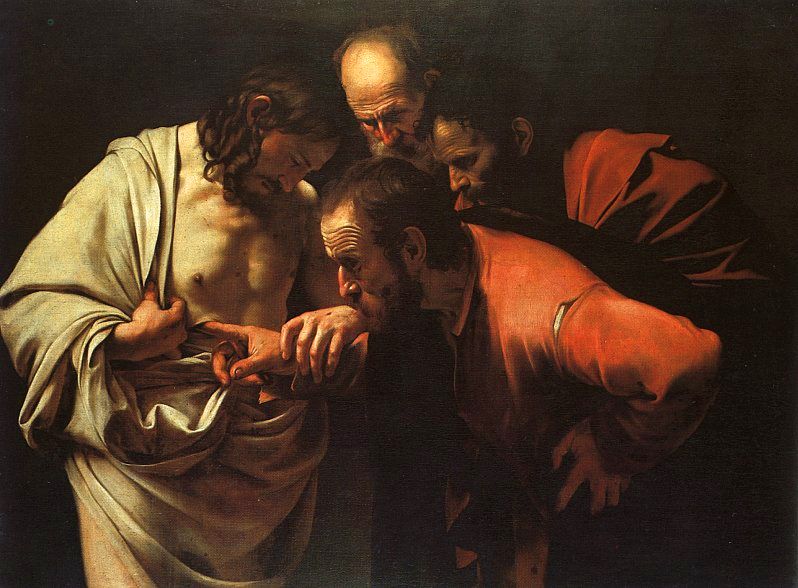
As I think about this text, the more I am drawn to the following conclusion: This might as well be the story of Doubting Tyler, or even worse, Unbelieving Tyler. Jesus never says to Thomas to stop doubting, but to not disbelieve! And so I find myself sitting in the front pew of a sanctuary where I have preached Christ crucified for years. Where I have both given and received forgiveness. Where I have seen Jesus do the impossible with some of our people. Yet, today, in this dark, musty, quiet room, I doubt. And if you are honest, you have joined me at some point, perhaps even today.
We wonder if Jesus really is who he says he is. Is he the great physician? Can he heal my grandfather? Does he care about me? Was he with me when I was abused? Did he hear me when I called out to him in panic? Unless I see Jesus work, unless I see him heal my marriage, unless I see him bring restoration to that little girl’s family, I will NEVER believe! Seeing is believing, is it not?
And yet, as he does with Thomas, Jesus still meets us in our unbelief. He does not chastise us. He does not tell us to go sit in the corner. He tells us to touch him and believe. Look to the chalice of promise and the bread of life. “Take, eat. This is my body which is given for you. Take, drink. This is my blood shed for you for the forgiveness of your sins.”
Of your unbelief.
In our times of doubt and straight unbelief, Jesus still gives himself to us. He still assures us of his promises. That he is who he says he is. That he is risen. That he has overcome the world. That he will never leave us, nor forsake us.
So come, touch, taste, and see that the Lord is good (Psalm 34:8).

 Rev. Tyler Cronkright