If you have been in the church long enough, I can just about guarantee that you have been involved in a discussion regarding “worship wars.” Allow me to explain if this is the first time that you have heard this phrase, which I despise by the way. There are groups of progressive Christians that desire to transition from a traditional worship style to what you might call contemporary worship, or “CoWo” if you’re a dork.
A “contemporary church” is typically defined by its music choice. Normally there is a worship leader with a band and a few singers. I have been at a church where one woman played guitar and sang, leading the congregation in worship. It was beautiful! The service will open with a few songs, there might be a prayer, a single Scripture reading, a 25-30 minute message, the Lord’s Supper (if you’re a Lutheran), and a closing song or two. A church like this will also showcase a number of congregants wearing…wait for it…jeans! Oh no. It’s a much more casual atmosphere which can be a big draw for a new Christian.
The “traditional church” is most commonly marked with the anti-contemporary instrument – the organ. You begin with the Invocation, responsive reading of a few verses leading up to Confession and Absolution, followed by the Introit, Kyrie, Gloria, Collect of the Day, and not one but three Scripture readings, recitation of the Nicene Creed (or Apostles’ Creed), with the 10-12 minute sermon concluding the Service of the Word. There is then the Service of the Sacrament with the Preface, the Sanctus, the Lord’s Prayer, the Verba (or Words of Institution), the Pax Domini, the Agnus Dei (don’t you love all of these fancy words?), the distribution of the Lord’s Supper, ending with the Nunc Dimittis. There is a lot of chanting, a lot of singing hymns, a lot of listening and response. It can get incredibly repetitive and boring. But it also happens to be my preferred style of worship.
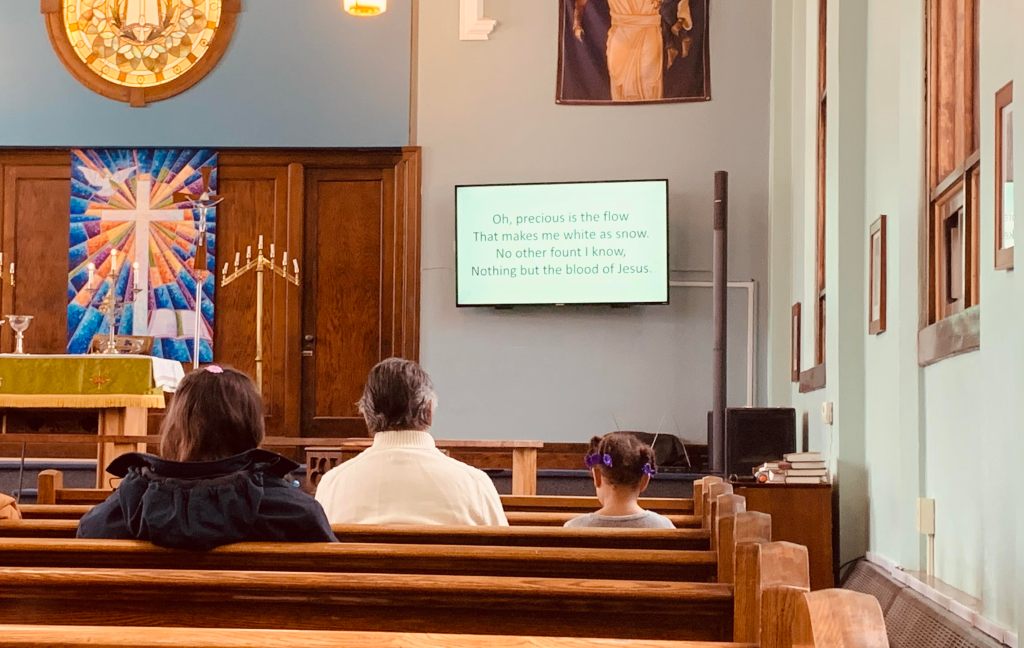
There is power in liturgy. Repeating the same words, singing the same songs, chanting the same verses all submit important Biblical truths to memory. If you don’t believe me, ask Lucy. Lucy is 3, almost 4-years old. She and her sister come to Family of God every Sunday with their Grandma. Sunday worship service looks exactly the same every Sunday, just with different readings and different songs, so Lucy knows what to expect every time she runs into the sanctuary. One of the things that she knows to expect is singing the song “White As Snow” after receiving absolution. While she cannot read yet, she knows every single important word of this beautiful song, that we have sung every Sunday at Family of God for the last 10 years:
“White as snow, white as snow, though my sins were as scarlet, Lord I know, Lord I know that I’m clean and forgiven. Through the power of your blood, through the wonder of your love, through faith in you I know that I can be white as snow.”
I noticed her singing along and dancing to this song on Sunday. I was ecstatic to see her run up to the Lord’s Table to receive a blessing, because she knew that “it was time” after seeing Pastor Hill say the Words of Institution. She also knows to fold her hands when she hears the congregation say, “Our Father, who art in Heaven…” She has been submerged into the same liturgy every single Sunday and at age 3 can clearly communicate to anyone who asks that “Jesus died for my sins because he loves me.”
This, friends, is the power of liturgy in our churches. Don’t be so quick to dismiss it. Embrace it and see that it has the potential (through the Holy Spirit) to form our faith so that we can sing with Lucy, “though my sins were as scarlet…I can be white as snow.”
 Rev. Tyler Cronkright
I never say CoWo (never even heard of it) so I’m glad to hear I’m not a dork! That’s inside code talk for dorky pastors is right!
You made the traditional service sound terrible with all the proper ecclesiastical words! It’s beautiful and your point is well described – familiarity, comfortable. But it is a foreign language to new comers. We need both.
LikeLike
The church my sister goes to LCMS has a Traditional Service at 8:30 and a Contemporary Service at 11:00. Works well with them and of course she prefers the Traditional Service but I have a cousin who prefers the Contemporary Service.
LikeLike